
Chelsea Green Pharmacy
A cholesterol reading on a results sheet can look like a small, unremarkable number, until you start wondering what it actually means for your health. It is one of the most common questions we hear at our Chelsea clinic: is a cholesterol level of 5.7 high? The honest answer sits in a grey area that is worth understanding properly, rather than guessing at. Our private blood testing service in Chelsea gives you clear results and the guidance to make sense of them.
If you have recently seen a reading like this on your own results, or want to check your levels for the first time, contact our team or book a cholesterol check at our Chelsea clinic today.
Quick Answer
A total cholesterol level of 5.7 mmol/L falls into the borderline high range, above the ideal level of below 5.0 mmol/L, but below the higher risk threshold of 6.0 mmol/L and above. It is not usually an emergency, but it is a sign to look closer at your LDL, HDL and triglyceride breakdown, and to consider lifestyle changes to reduce your long-term cardiovascular risk.
Understanding Cholesterol Readings
When you receive a cholesterol blood test, you will often see several different figures on your results. These represent the different types of cholesterol and related fats in your blood, and each plays a different role in your overall heart health.
| Marker | What It Measures | Why It Matters |
|---|---|---|
| Total cholesterol | The overall amount of cholesterol in your blood, including HDL and LDL | Gives a general overview, but not the full picture on its own |
| LDL cholesterol | Low-density lipoprotein, often called “bad cholesterol” | Can build up in blood vessels, increasing risk of narrowing and blockages |
| HDL cholesterol | High-density lipoprotein, often called “good cholesterol” | Helps remove excess cholesterol from the bloodstream |
| Triglycerides | Another type of fat found in the blood | Elevated levels combined with high LDL can raise heart disease risk |
A full blood test will usually provide readings for all these markers, allowing your healthcare provider to assess your overall risk and provide personalised recommendations. Our clinic offers comprehensive blood testing in Chelsea to give you a clear picture of your health and support you with tailored advice based on your results.
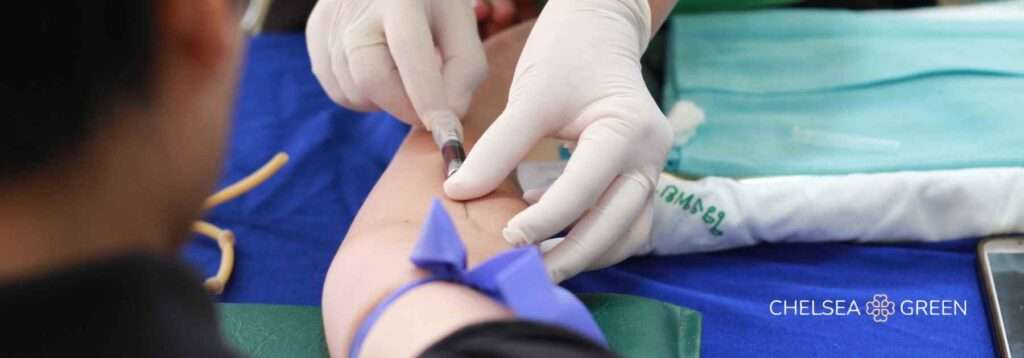
Is A Cholesterol Level Of 5.7 High?
In the UK, total cholesterol levels are typically measured in millimoles per litre (mmol/L). For most adults, the following ranges are commonly used as a guide:
- Ideal cholesterol: below 5.0 mmol/L
- Borderline high: between 5.0 and 6.0 mmol/L
- High cholesterol: above 6.0 mmol/L
With a total cholesterol reading of 5.7 mmol/L, you fall into the borderline high range. This does not necessarily mean you have an immediate health problem, but it may indicate that lifestyle adjustments are needed to lower your risk of future heart-related issues.
Because total cholesterol alone does not give the full picture, it is important to look at the breakdown between HDL, LDL and triglycerides. For example, someone with a total cholesterol level of 5.7 but high levels of protective HDL cholesterol and low LDL cholesterol may have a lower cardiovascular risk than someone with the same total cholesterol but higher LDL levels.
Our team helps you interpret your blood test results in detail and explain what they mean for your overall health. Our pharmacists provide practical advice on managing cholesterol through diet, lifestyle changes and, where necessary, referral to your GP for further assessment or treatment.
When To Seek Advice
A cholesterol level of 5.7 mmol/L is not usually a cause for immediate concern, but it is a sign to pay closer attention to your heart health. You should consider seeking advice if:
- You have other risk factors such as high blood pressure, diabetes or a family history of heart disease
- Your LDL cholesterol levels are above the recommended range
- You have had previous cardiovascular problems
- You are unsure how to make lifestyle changes to lower your cholesterol
Even if you feel healthy, raised cholesterol can silently increase your risk of developing serious health problems over time. Making changes early can have a significant impact on your long-term wellbeing. This could include adopting a healthier diet, increasing physical activity, reducing alcohol intake, stopping smoking and managing stress levels.
Our team can work with you to create a practical plan to support your goals and improve your results over time. Regular testing is also important to monitor progress and make adjustments where needed.
Practical Steps To Help Lower A Borderline Reading
If your cholesterol falls into the borderline high range, small and consistent changes often make more difference than drastic short-term measures. Useful steps include:
- Swapping saturated fats, such as butter and fatty cuts of meat, for unsaturated fats like olive oil and oily fish
- Increasing soluble fibre intake through oats, beans, and lentils
- Building in regular movement, such as brisk walking, most days of the week
- Reducing alcohol intake, which can affect triglyceride levels
- Stopping smoking, which lowers HDL and damages blood vessel walls
- Managing weight gradually, particularly around the abdomen
These changes tend to work best when introduced gradually and maintained consistently, rather than attempted all at once.
Common Questions About Cholesterol Readings
Cholesterol results often raise more questions than they answer, especially when a number sits in a borderline range. Here are some of the queries we hear most often from patients at our Chelsea clinic.
Can cholesterol levels change from day to day, or even during the same day?
Yes, to some degree. Cholesterol levels can fluctuate slightly due to factors such as recent meals, hydration, illness, or stress. This is one reason why a single borderline reading, such as 5.7 mmol/L, is not usually treated as a fixed, permanent figure. If a result is unexpected or concerning, repeating the test after a short period can help confirm whether it reflects a genuine pattern rather than a temporary fluctuation.
Does age or sex affect what counts as a healthy cholesterol level?
To some extent, yes. Cholesterol levels naturally tend to rise with age, and there are some differences in typical ranges between men and women, partly influenced by hormonal factors. Rather than applying a single fixed target to everyone, clinicians often consider your age, sex, family history, and other risk factors alongside the raw number when assessing what a healthy target looks like for you specifically.
Can high cholesterol run in families even with a healthy lifestyle?
Yes. A condition called familial hypercholesterolaemia is an inherited disorder that causes significantly raised cholesterol levels from a young age, regardless of diet or exercise habits. It is far less common than lifestyle-related raised cholesterol, but it is an important reason why a family history of early heart disease or very high cholesterol should always be mentioned during a consultation, as it may prompt further specific testing.
How soon could lifestyle changes actually lower a borderline reading?
Many people see measurable improvements within around 8 to 12 weeks of consistent dietary and lifestyle changes, though this varies between individuals. Triglycerides often respond fairly quickly to changes such as reduced alcohol intake, while LDL cholesterol may take a little longer to shift meaningfully. Retesting after a few months gives a much clearer sense of whether your changes are having the intended effect.
Is it possible to have high cholesterol but still be a healthy weight?
Yes, this is more common than many people assume. Cholesterol levels are influenced by a combination of genetics, diet composition, liver function, and lifestyle factors, not just body weight. Some people who are a healthy weight still have raised LDL cholesterol due to family history or dietary patterns, which is why cholesterol testing is worthwhile even for those who consider themselves generally fit and healthy.
Do I need to fast before a cholesterol blood test?
This depends on which specific test is being carried out. Some cholesterol panels require fasting for around 9 to 12 hours beforehand, particularly if triglycerides are being measured accurately, while other non-fasting tests can still provide a useful general picture. Our team will confirm exactly what is needed for your chosen test when you book, so you know how to prepare.
Where can I get a private cholesterol test in Chelsea?
Our clinic is based at 6 Elystan Street, Chelsea, London, SW3 3NS, and offers private cholesterol and full lipid panel testing without the need for a GP referral. You can book directly through our website or by calling 0207 584 5424, and our pharmacists will talk you through your results and next steps clearly.
Book A Cholesterol Check In Chelsea
If you have recently had a private or NHS blood test showing a cholesterol level of 5.7 or you are unsure about your current levels, our blood testing in Chelsea offers a simple, accurate and confidential way to understand your results. We provide detailed explanations, personalised advice and ongoing support to help you take control of your heart health.
Booking a consultation gives you access to professional guidance from experienced pharmacists who can help you interpret your readings and make informed decisions about your next steps.
Whether you need reassurance, lifestyle advice or a referral for further care, we are here to support you.
Take the first step towards better heart health today. Contact us to arrange your cholesterol check and get expert advice tailored to your needs.
☑ Clinically Reviewed
A pharmacist reviews the content to help ensure medicines are presented responsibly and that patient-facing health information is accurate, appropriate, and aligned with current clinical guidance.
Last reviewed: September 2026
